The Space Beneath Your Home Is More Important Than You Think
If your Thousand Oaks home is built on a raised foundation with a crawl space, that below-floor environment has an enormous influence on the structural health, air quality, and energy efficiency of everything above it. Yet most homeowners in Thousand Oaks, North Ranch, and Westlake Village haven't set foot in their crawl space in years — and have no idea what's happening down there.
In Southern California, the assumption is that dry weather means dry crawl spaces. The reality is more complicated. Thousand Oaks receives concentrated winter rainfall, many properties run irrigation systems near the foundation year-round, and the clay soils common across the Conejo Valley hold moisture against concrete and wood for extended periods after rain events. The result: crawl spaces that are far wetter than homeowners expect, and that suffer real structural and air quality consequences when left unaddressed.
What's Really Happening in an Unprotected Crawl Space
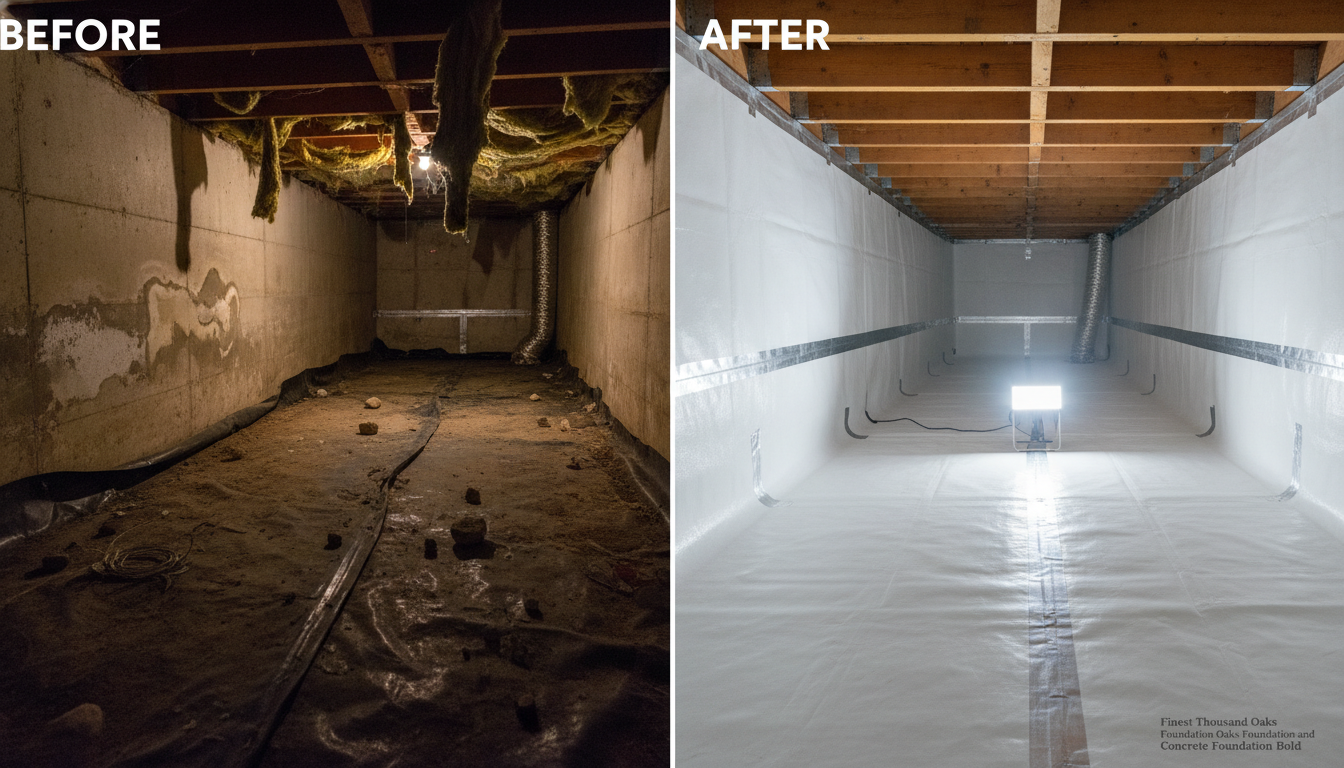
An unencapsulated crawl space typically has an old, thin plastic vapor barrier — or no barrier at all — on the dirt floor. The vents around the perimeter bring in outside air, which during Thousand Oaks' winter rainy season is humid. That moist air meets the cooler surfaces inside the crawl space and condensation forms on wood floor joists, the subfloor, and any insulation batts hanging overhead.
Over time, this leads to a predictable cascade of problems:
- Wood rot: Moisture causes floor joists, girders, and posts to soften, decay, and eventually lose structural integrity — leading to the bouncy or soft floors homeowners notice in living areas above.
- Mold and mildew: Dark, damp crawl spaces are ideal environments for mold growth. Spores produced in the crawl space migrate upward through gaps in the subfloor into living areas, affecting indoor air quality and potentially triggering respiratory symptoms.
- Pest infestation: Rodents, termites, and wood-boring beetles favor moist, undisturbed wood. A damp crawl space is an invitation.
- Foundation deterioration: Moisture held against concrete piers and stem walls causes efflorescence, spalling, and in severe cases, rebar corrosion that weakens the structural members supporting your floor system.
- Insulation failure: Wet fiberglass batt insulation loses much of its R-value and can sag or fall from joist bays, significantly reducing your home's thermal envelope.
How Crawl Space Encapsulation Works
Our crawl space encapsulation and repair service transforms a damp, vulnerable below-grade space into a dry, conditioned, and structurally stable environment. The process involves several coordinated steps:
Step 1: Inspection and Structural Assessment
Before any encapsulation work begins, our team performs a thorough inspection of the crawl space — the same methodical approach we use during a full foundation inspection and assessment. We evaluate the condition of wood floor joists, girders, posts, and concrete piers; document moisture levels and any existing mold or rot; and identify the sources of moisture intrusion.
Step 2: Structural Repairs
Encapsulating a crawl space without repairing damaged structural members is like painting over rust — it looks better temporarily but doesn't solve the underlying problem. We repair or sister deteriorated floor joists, replace rotted wood posts, and address any foundation settlement that has caused the crawl space framing to shift. This structural work is what restores the solidity of your floors above.
Step 3: Vapor Barrier Installation
We install a minimum 12-mil reinforced polyethylene vapor barrier across the entire dirt floor, overlapping seams and sealing them with moisture-resistant tape. The barrier is also run up the crawl space walls and sealed to the foundation, creating a continuous moisture envelope. This is significantly more robust than the thin 6-mil sheeting found in older homes — it resists tearing during any future access and lasts for decades.
Step 4: Vent Management and Air Conditioning
Traditional crawl space vents that bring outside air in are closed and sealed as part of a full encapsulation. Conditioned air from the home's HVAC system, or a dedicated crawl space dehumidifier, maintains the enclosed space at a stable, dry humidity level year-round. This eliminates the seasonal condensation cycle that drives moisture problems.
Step 5: Drainage Integration When Needed
For crawl spaces where bulk water intrusion is a factor — not just ambient humidity — we integrate the encapsulation with our foundation waterproofing solutions, installing perimeter drain channels and a sump pump to actively remove any water that enters before it can cause damage. This layered approach is particularly important for homes in lower-lying areas or on properties with significant irrigation near the foundation perimeter.
The Benefits Thousand Oaks Homeowners Notice
Homeowners who complete a full crawl space encapsulation consistently report several immediate and longer-term improvements:
- Floors feel firmer and more solid once damaged structural members are repaired and the moisture that was softening them is eliminated.
- Musty odors disappear from the home's interior once the mold and moisture source beneath the floor is sealed off.
- Energy bills decrease — research indicates properly encapsulated crawl spaces can reduce heating and cooling costs by 15–20% by eliminating infiltration of unconditioned outside air through the floor system.
- HVAC equipment lasts longer because it's no longer working as hard to condition air leaking in from below.
- Peace of mind that the structural wood holding up your floors, walls, and roof is dry, intact, and protected going forward.
Is Your Home a Candidate for Crawl Space Encapsulation?
Not every Thousand Oaks home has a crawl space — many are built on slab foundations. But if your home is on a raised foundation, you likely have a crawl space that could benefit from professional evaluation. Some questions to consider:
- Do you notice musty or earthy odors in any room of your home, especially in the morning?
- Do your floors have any soft, bouncy, or squeaky sections?
- Has it been more than a few years since anyone inspected or serviced the crawl space?
- Did the previous vapor barrier installation use thin poly sheeting that may have deteriorated?
- Do you live in Lake Sherwood, Lynn Ranch, or another area with naturally higher ground moisture?
If you answered yes to any of these, a crawl space inspection is a worthwhile investment in your home's long-term value and structural health.
Get a Crawl Space Assessment from Finest Thousand Oaks Foundation and Concrete
Our team enters the crawl spaces other contractors avoid — tight, dim, and difficult to navigate — because we know what's at stake for your home's structural integrity. We serve Thousand Oaks, North Ranch, Westlake Village, Lynn Ranch, Lake Sherwood, and the broader Conejo Valley, Monday through Sunday from 8:00 AM to 6:00 PM.
Call us at (820) 777-4449 or reach out by email at [email protected] to schedule a crawl space inspection and find out exactly what's happening beneath your Thousand Oaks home.
Discuss This With Our Team
Call +18207774449 or fill out our online form for a free, no-obligation quote.
Request Free Quote